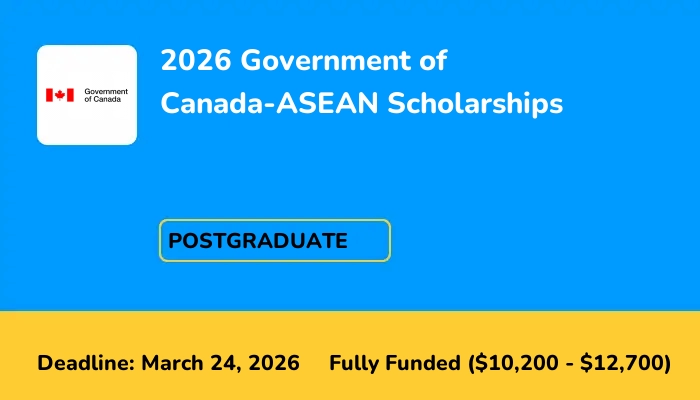
The Government of Canada is offering scholarship opportunities in the Indo-Pacific region through the Scholarships and Educational Exchanges for Development – Phase 2 (SEED-2) program. This program is an expansion of the Canada-ASEAN Scholarships and Educational Exchanges for Development (SEED). SEED-2 is a key initiative under Canada’s Indo-Pacific Strategy. The program provides opportunities for students from Member States of the Association of Southeast Asian Nations (ASEAN), Pacific Island Countries and Mongolia to conduct short-term study or research in Canadian post-secondary institutions in areas that contribute to the implementation of the 2030 Agenda for Sustainable Development .
The Scholarships and Educational Exchanges for Development – Phase 2 (SEED-2) program aims to reduce poverty in eligible countries and to achieve the 2030 Agenda for Sustainable Development . Scholarships and educational exchanges will contribute towards the achievement of the Sustainable Development Goals (SDGs). SEED-2 contributes to strengthening people-to-people ties between Canada and the Indo-Pacific region.
The Scholarships and Educational Exchanges for Development – Phase 2 (SEED-2) program is offered by Global Affairs Canada. SEED-2 scholarships are facilitated through institutional collaborations between post-secondary institutions in Canada and their partner institutions in ASEAN Member States, Pacific Island Countries and Mongolia. Canadian institutions must apply on behalf of eligible candidates.
Subscribe for scholarship update!
Be among the first to know whenever new Government of scholarship is going on
Canada Postgraduate Scholarship
Aim and Benefits of Canada Postgraduate Scholarship
Selected candidates may use scholarship funds towards:
- visa or study/work permit fees
- airfare via the most direct and economical route
- health insurance
- living expenses, such as accommodation, utilities and food
- ground transportation, including a public transportation pass
- books and supplies required for their study or research, excluding computers and other equipment
Canadian institutions are eligible to receive:
- $500 per scholarship recipient to aid with administrative costs once the student arrives in Canada
- reimbursement of additional employer compliance fees paid to Immigration, Refugees and Citizenship Canada in some cases
Tuition must be waived by Canadian institutions.
Requirements for Canada Postgraduate Scholarship Qualification
To be eligible, candidates must be:
- citizens of a country listed below:
- ASEAN Member States: Brunei Darussalam, Cambodia, Indonesia, Laos (Lao People’s Democratic Republic (Lao PDR)), Malaysia, Myanmar, The Philippines, Singapore, Thailand, Timor-Leste, Vietnam;
- Pacific Island Countries: Cook Islands, Fiji, Kiribati, Marshall Islands, Micronesia, Nauru, Niue, Palau, Papua New Guinea, Samoa, Solomon Islands, Tonga, Tuvalu, Vanuatu;
- Mongolia.
- enrolled full-time at a post-secondary institution in an eligible country
- paying tuition fees to that institution at the time of application and for the full duration of their exchange
Candidates are not eligible for this scholarship if they:
- hold or have a pending application for Canadian citizenship or permanent residency
- are already participating in a scholarship program funded by the Government of Canada
- are already enrolled in a degree, diploma or certificate program at a Canadian post-secondary institution
- have previously received a scholarship under the first phase of the program: the Canada-ASEAN Scholarships and Educational Exchanges for Development (SEED)
Canadian post-secondary institutions interested in hosting students must:
Interview date, Process and Venue for Canada Postgraduate Scholarship
Applications are evaluated based on:
- the linkage of the proposed research or study that the student will undertake in Canada to the 2030 Agenda for Sustainable Development
- the candidate’s commitment to use their proposed research or studies in Canada to help reduce poverty and narrow the development gap in the ASEAN region, the Pacific Island region or Mongolia
- merit of the research or study to be undertaken in Canada
- benefit to the home institution and peers
- benefit to the Canadian institution, supervisor and peers
- rankings submitted by the Canadian institution
The types of institutional collaborations (and any related Memoranda of Understanding (MOU) or student exchange agreements) are determined by the Canadian institutions and their partner institutions in the eligible countries, and will not be evaluated by the SEED-2 program. Tuition fees must be waived by Canadian institutions.
Documents Required for Application
Institutions must ensure documents are complete and accurate as per the instructions. Revised documents will not be accepted after the deadline. Documents in a language other than English or French must be accompanied by a translation.
- Proof of citizenship
- A copy of the candidate's passport or national identity card with a photo and valid dates
- Documents not accepted as proof of citizenship are: driver’s license, permanent residence card, work permit, student card, health card, birth certificate or baptismal certificate
- Proof of citizenship selected must be from the same country/territory as the citizenship selected in the online application form
- Signed Privacy Notice Statement
- Letter of intent from the candidate (maximum one page)
- Explains the nature of studies or research to be undertaken
- Provides rationale for study in Canada and for the choice of institution, program and supervisor and how the proposed program of study or research will relate to their future career
- Explains how undertaking study or research in Canada will empower the student to apply their learning to address the 2030 Agenda for Sustainable Development
- Explains how they intend to use their learning to help reduce poverty and narrow the development gap in their region in their future career
- Identifies the Sustainable Development Goal (SDG) their proposed study or research in Canada is aligned with and will contribute to (letters that do not identify an SDG will be deemed incomplete and not eligible)
- Candidates from Cambodia, Indonesia, Laos, Malaysia, Myanmar, the Philippines, Thailand, Timor-Leste or Vietnam must provide an explanation of how their learning in Canada will help to reduce poverty in their home country
- Candidates from Brunei or Singapore must provide an explanation of how their learning in Canada will help to reduce poverty in one of the other nine ASEAN countries
- Candidates from Fiji, Kiribati, Marshall Islands, Micronesia, Nauru, Niue, Palau, Papua New Guinea, Samoa, Solomon Islands, Tonga, Tuvalu or Vanuatu must provide an explanation of how their learning in Canada will help to reduce poverty in their home country
- Candidates from the Cook Islands must provide an explanation of how their learning in Canada will help to reduce poverty in one of the other thirteen eligible Pacific Island Countries
- Candidates from Mongolia must provide an explanation how their learning in Canada will help to reduce poverty in their home country
- Letter of proof of full-time enrolment from the home institution
- On official letterhead
- Dated within the last six months
- Confirms that the candidate is currently enrolled in a full-time program (letters that do not confirm full-time student status will be deemed incomplete and not eligible)
- Copies of transcripts, a student card or a letter of admission are not acceptable
- Letter of support from the home institution (maximum one page)
- On official letterhead
- Dated within the last six months
- From the candidate's instructor, professor or international director
- Explains the nature of study or research to be undertaken in Canada and how the candidate and the home institution will benefit from this scholarship program
- Assesses the candidate’s commitment and capacity to use the program of study or research in Canada to help reduce poverty and narrow the development gap in their country or region
- Letter of invitation from the Canadian supervisor (graduate students only, maximum one page)
- On institutional letterhead
- Dated within the last six months
- Signed by the Canadian supervisor
- Describes the nature and scope of the research collaboration with the student’s home institution
- Confirms their willingness to support and mentor the candidate during the exchange period
- Explains how the Canadian institution, supervisor and peers will benefit from the exchange
- A ranking of applications
- Based on the institution’s strategic priorities must be sent to [email protected]
- Must indicate the MyEduCanada application number of each candidate
Check also:
Mastercard Foundation Scholars' Program at ALCHE 2027
Global Korea Scholarship 2027
Application Deadline
March 24, 2026How to Apply
Application Instruction for Canadian Institutions
- Assign a program coordinator who will be responsible for completing the application.
- To access My EduCanada, you must first sign in or create an account through Global Affairs Canada Single Sign-On Services. Creating a GCKey account is recommended for institutions. Login or Register to begin.
- After creating your Global Affairs Canada Single Sign-On account, register your institution on My EduCanada. Be sure to select Institution for your account type.
- Once your account is activated and you are logged in, select Scholarships and Educational Exchanges for Development – Phase 2 (SEED-2) and click Apply.
- Enter data in the required fields and follow the instructions on the application form.
- Click Validate and save as you progress through the application form.
- Upload all required supporting documents. Each document must be smaller than 5 MB and in .jpg, .gif, .png, .pdf, .doc, .docx, .txt or .xlsx format.
- Review all components of your application for accuracy and completeness.
- Read and accept the conditions of the "Declaration and permission" statement. Click Submit. You will receive a confirmation message and a reference number for submitted applications.
- Print or download the form for your records using the “Print|Download” function.
For more information, kindly visit Government of Canada scholarship webpage.
 Menu
Menu